Showing posts with label PWM. Show all posts

Monday, April 5, 2010

Initial Thrust Testing

This past weekend we built a test platform in order to do some basic thrust tests with our motors and the two different props we have. This gave us a general understanding of how much current we need per motor in order to keep our aircraft hovering. We were able to more accurately determine this because we have our first body finished! There will be more on the body in following posts. The thrust test platform consisted of a lever made from ABS and a metric scale, so that prop thrust generated a proportional weight on the scale. By scaling this thrust by the ratio of the lever lengths we were able to get an approximate measurement of lift (in grams) versus current for our two props.

Thrust test bed:


Video of tri-blade ramping from idle to 8 Amps (12000 RPM):


Our findings indicate that the two prop configurations are similar, but at lower currents (as in hovering) the 2-blade prop is more efficient than the tri-blade, and at higher currents (above 5 amps) the opposite is true.

Thrust vs. Current plot:


The difference in efficiency at high and low current output is particularly evident when plotting RPM versus current as in the figure below. Note that at higher currents the dual-blade prop has a lower RPM gain per Amp than the tri-blade, and the tri-blade has a higher RPM gain per Amp than the dual-blade at lower amps. The general difference in RPM between the tri-blade and dual-blade is due mostly to the diameter of the props.

RPM vs. Current


To determine the efficiency of our system, we measure the entire weight of our body (adding on some weight to for wires to be conservative) with a particular battery, and determine the hover time based on battery capacity and the current required to hover.

For example, using Blue Lipo lithium polymer batteries with 2200 mAh (at about 185g) we have a total body weight of 615g. In order to hover we need each motor to generate 615/4 or about 154g of "thrust". With the tri-blade this corresponds to about 2.2 Amps per motor (8.8 Amps total). With the dual-blade this corresponds to about 1.8 Amps per motor (7.2 Amps total). With our 2200 mAh battery, this gives a flight time of:

Tri-blade -- 2.2 Amps*Hour * (60 min / Hour) * (1 / 8.8 Amps) = 15 minutes
Dual-blade -- 2.2 Amps*Hour * (60 min / Hour) * (1 / 7.2 Amps) = 18.3 minutes

This indicates that at hovering, the dual blades are (18.3-15) / 15 * 100% = 22% increase with respect to the tri-blade efficiency. This, however, was not enough to convince us to use the two blade props over the three blade props...the tri-blades are much quieter and, let's face it, look way too badass.

With a 1500 mAh Mystery Lipo we found the following flight times using the same metric:

Tri-blade = 12.5 minutes
Dual-blade = 15 minutes

Here's the mess we made in the undergraduate electrical engineering lab:

Thursday, March 25, 2010

9DOF Board Has Arrived!

Alright, so a few updates since the last post:

The 9DOF IMU (Inertial Measurement Unit) has arrived today from SparkFun. At 1.95" x 1.10", the board is only slightly larger than the MaEvArM. Currently, the connections are set so that the board outputs all of the sensor data over the serial output (Tx and Rx pins), however we'll be looking into the other possible connectors on the board (look like SPI). If they are, we may be able to use the board to grab data from our barometric pressure unit, which also arrived today. This keeps the sensor data separated from our main processor (the Atmega32U4 on the MaEvArM) which will be doing the PID and motor control. More on this board will be posted soon.


9DOF Razor from Spark Fun


FTDI USB to Serial adapter from Spark Fun:


Barometer IC from Spark Fun:


MaEvArM Microcontroller with ATMega32u4:


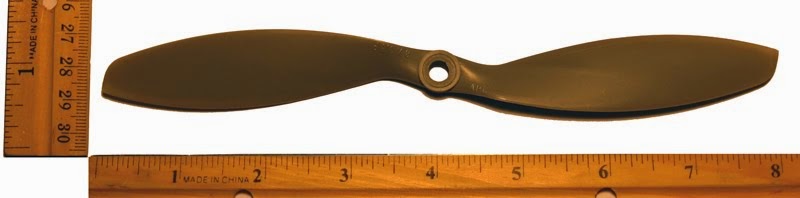
The props have arrived. We've decided to get a couple variations to test which works best. (All our sets consist of two normal and two counter-rotating blades. This prevents us from having to tilt the motors in order to counteract the rotational inertia).
  • The first set are two-blade, 8x3.8 props. (8" diameter, 3.8 blade pitch). These are fairly large rotors and have decent specs when run on our motors (will post more detailed results later).


  • The second set are tri-blade, 7x3.5 props (7" diameter, 3.5 blade pitch). After some research, it was found that tri-blade props can be quieter than dual-blade when run at the same speed. We'll also post tests with these props once the motors come in (still on their way from Singapore!).


Lastly, we've been starting to program the MaEvArM's basic tasks to ensure that our specifications will be made. So far, two main tasks have been tested and working properly:
  • Four 16-bit PWM channels (0-65536 resolution) have been tested to control the four motor controller (Brushless ESCs). With the System Clock set to 8MHz, a 150Hz output signal was able to be generated with a resolution of 0-53333 (this will have to be tested with the ESCs since they normally take 50Hz Remote Control Standard servo controls).
  • Buffered Interrupt-controlled serial communication was successfully accomplished by modifying the AVR306 (Atmega UART) code to work with the Atmega32U4 registers. This will allow us to read the output from the 9DOF board without wasting CPU usage (allowing for our PID calculations, PWM Control, and Wireless Receive to run continuously). This code uses a Circular Buffer technique to get store data when the CPU is in use and read it when it has time to.

That's it for now, but we'll keep you updated with our progress!